

.png)
We're proud to announce we’ve led Bower's A$2m Pre-Seed round. Here’s the team we’re backing and what convinced us.
AI is transforming nearly every knowledge profession - legal drafting, marketing creative, medical documentation - yet science has been left behind. In laboratories around the world, researchers are still capturing observations on paper, transcribing notes after the fact, and watching decades of irreplaceable institutional knowledge walk out the door when a senior scientist retires. This isn't because scientists resist technology; it's because every existing tool asks them to stop doing science in order to document it. Against a backdrop of global R&D spend measured in the trillions and a laboratory informatics market growing at a healthy clip, that's a large and structurally underserved problem.
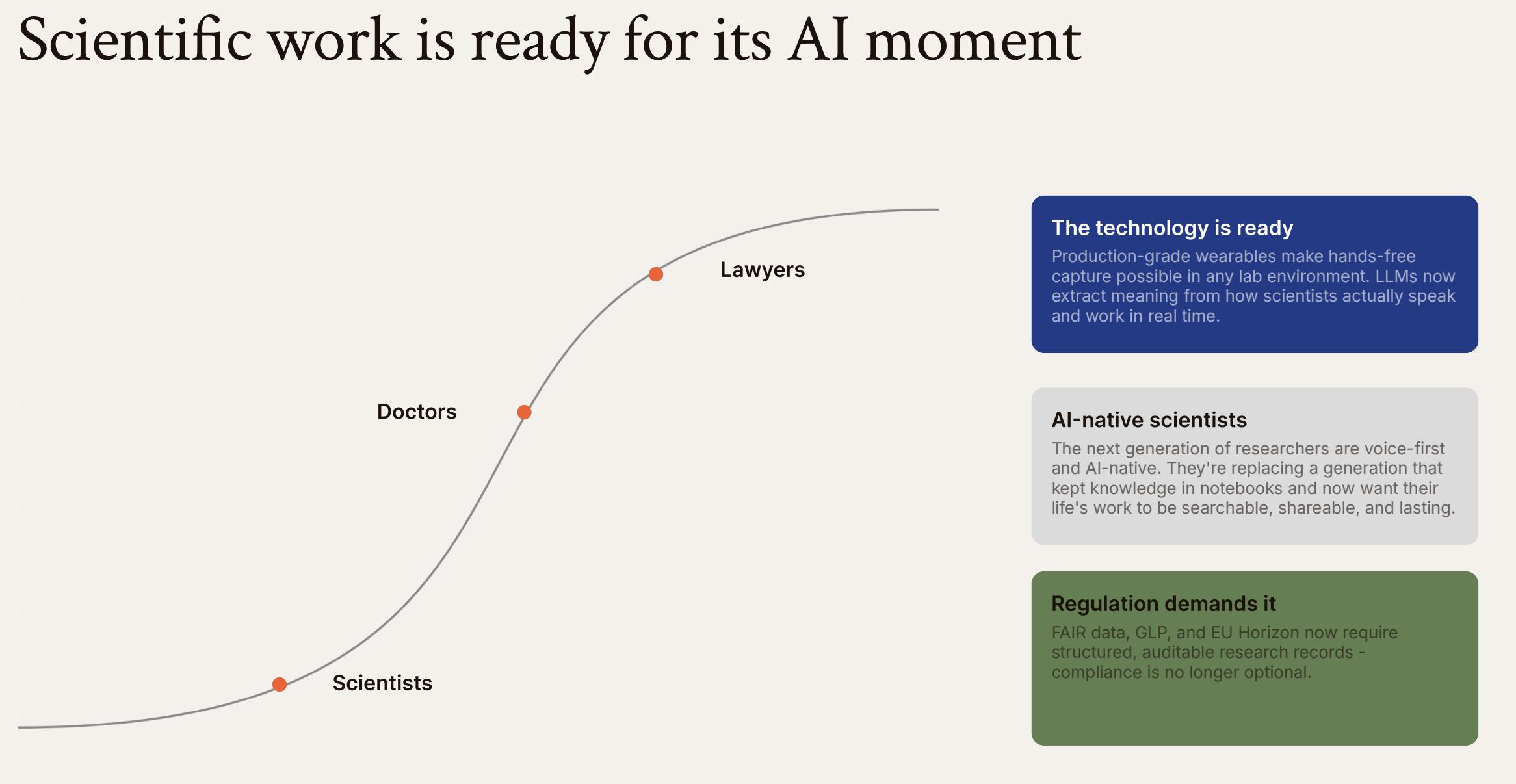
Bower is the voice and mobile-first AI research partner for scientists. It captures scientific observations hands-free at the moment they happen - voice, photo, and text - makes everything instantly searchable, and maintains the rigorous traceability that science demands. Crucially, Bower doesn't ask scientists to change how they work. It sits alongside the tools a lab already uses and captures what they miss: the observation spoken aloud mid-experiment, the small adjustment made on the fly, the photo of an instrument reading at the time of record.
Why We Love This Deal
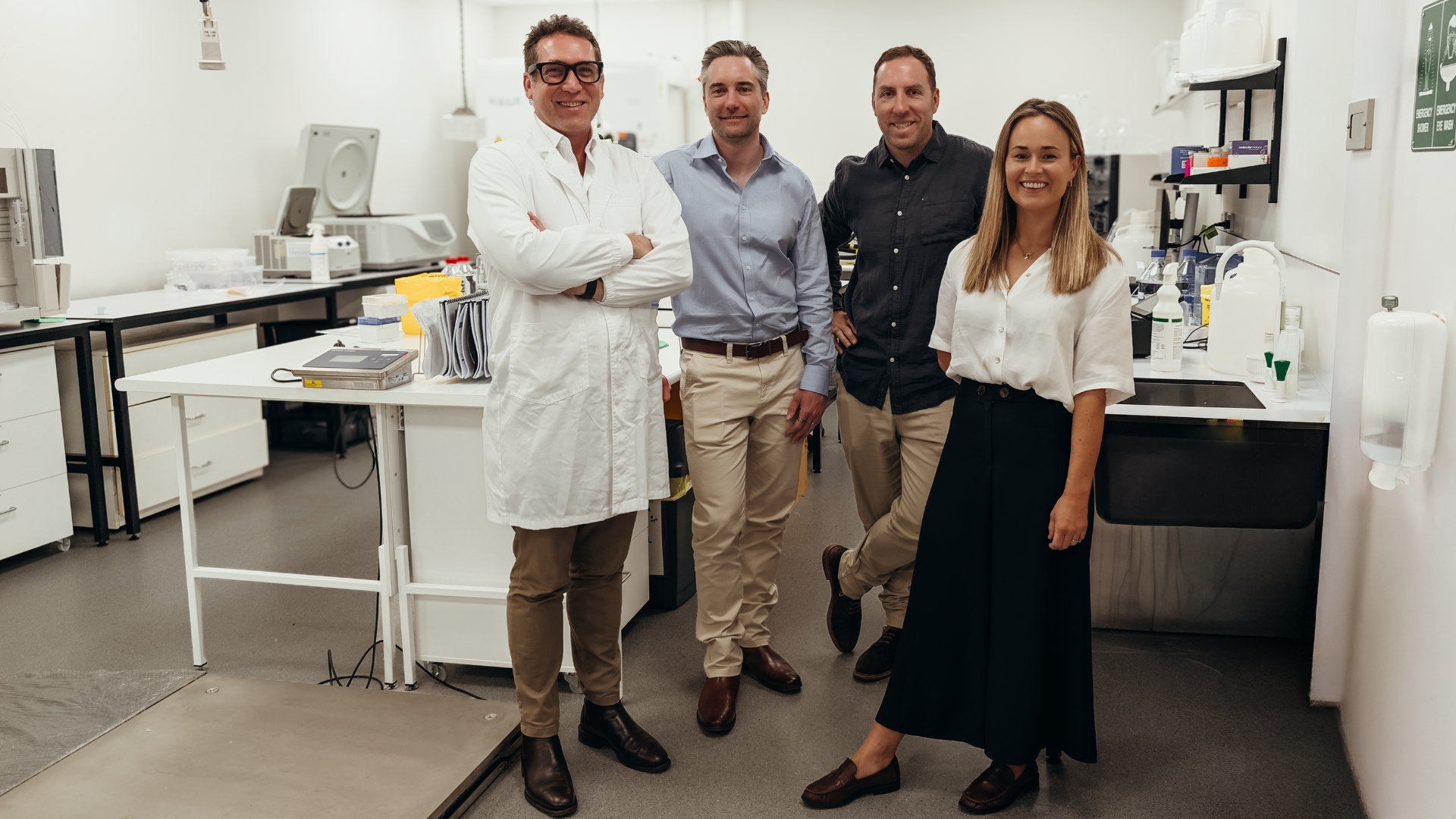
- The founding team is exceptional. Bower has a rare combination of product, commercial, engineering, and deep scientific domain expertise in a single founding group. Founded by four friends in 2025 - Michelle "Mish" MacRae (CEO) has built 0-to-1 AI products at Microsoft (Clipchamp), Dovetail, and Google, James Boysons (COO/CRO) scaled revenue at VC-backed EQL and held senior commercial roles at Google, David Lyon (CTO) built knowledge graphs at Atlassian and went through Y Combinator with Boardcave and Renaud Joannes-Boyau (Chief Science Officer) is a world-class scientist with global research networks and 150+ publications. Few early-stage companies have access to such broad and deep talent in their founding team.
- The problem is validated - and quantified. More than 70% of researchers have tried and failed to reproduce another scientist's experiments - a widespread failure attributable in significant part to inadequate real-time documentation. The annual cost of irreproducible preclinical research in the US alone is estimated at US$28B. The founding team spoke independently to researchers across disciplines, career stages, and geographies, their conversations confirmed similar pain points.
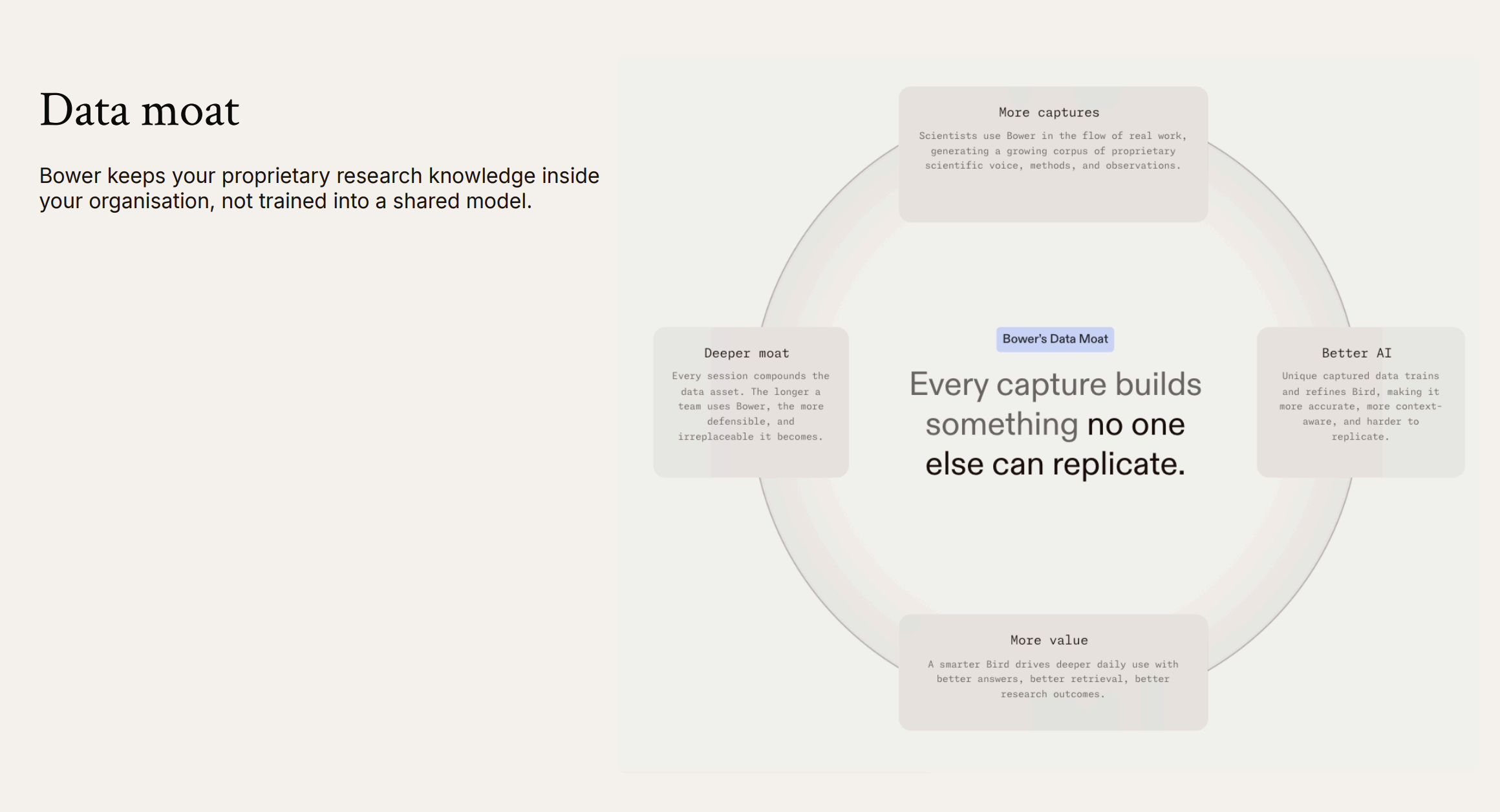
- A three-layer compounding moat. Bower's defensibility compounds across three layers simultaneously. The data layer: every voice capture, Optical Character Recognition (OCR) correction, and researcher edit becomes a training signal for domain-specific models that no generic tool can replicate - by Series A, Bower will have accumulated proprietary scientific workflow data with a feedback loop that widens with each new researcher. The workflow layer: deep integration into how scientists actually work creates switching costs that accumulate over time - a researcher's notes, protocols, search history, and institutional knowledge live in Bower, making it increasingly costly to leave. The platform layer: as Bower becomes the system of record, it becomes the natural integration point for instruments, Electronic Lab Notebooks, publishers, and AI agents - each integration deepening lock-in further. Better AI attracts more researchers to Bower, who generate more captures, which produce more corrections, which improve the AI, which makes the platform more valuable to integrate with.
- Regulatory tailwinds create urgency for institutional buyers. EU Horizon mandates FAIR data management plans within six months of project start. NIH and federal agencies are tightening open access and GLP requirements. Bower solves this natively - making compliance a byproduct of capture rather than a burden on top of it. Compliance urgency creates a pull that reduces the cost of sales.
- Wearables timing is a structural advantage. The smart glasses market grew 110% in H1 2025 and the hardware is converging on exactly the form factor scientific work demands: hands-free, always-on capture without a device to pick up with gloved hands. Bower is already running on it - the first AI-native lab platform with a live integration on Meta Ray-Bans, with early access to Google Android XR. Every other platform entering this space is building for consumers. Bower's software-first approach - running Bird, its AI agent, across any hardware via MCP - means the position compounds as more devices arrive, without dependency on any single platform winning.
Problem
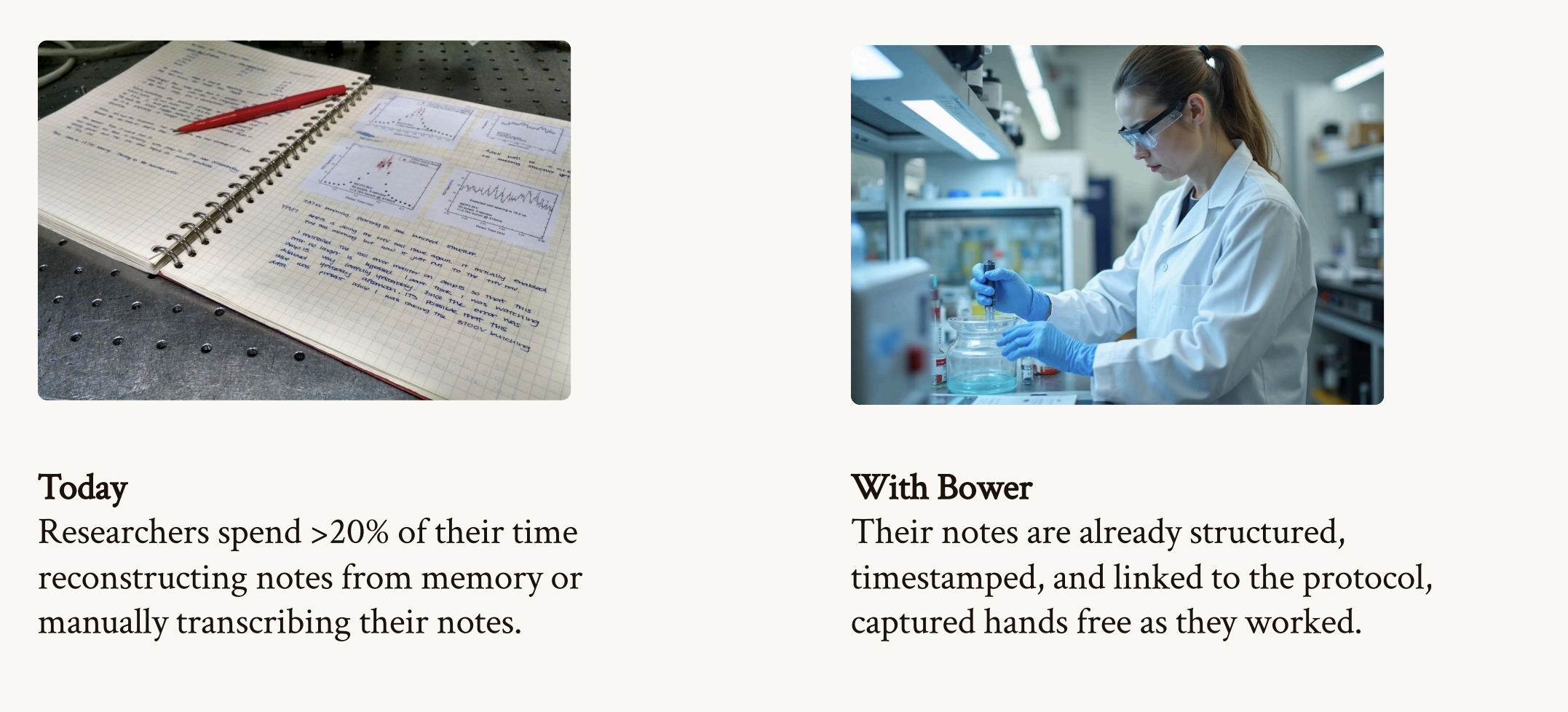
Science today produces more data, more papers, and more complexity than at any point in history. Yet the way scientists record their work has barely changed in decades. In the lab and in the field, research is still documented with pen and paper, fragmented files, voice memos, photos of notebooks, and external hard drives - not because that's preferred, but because proper documentation is impractical when you're wearing gloves, handling samples, working in a sterile environment, or out in remote field conditions.
The consequences are familiar across institutions: observations captured inconsistently or not at all, data lost in transcription, context disappearing between experiments, and senior researchers retiring with decades of undocumented knowledge. Most existing tools fail because they ask scientists to change their behaviour - and usually after the work is already done. Adoption doesn't fail because scientists don't care about quality or reproducibility. It fails because these tools get in the way of doing science.
Solution
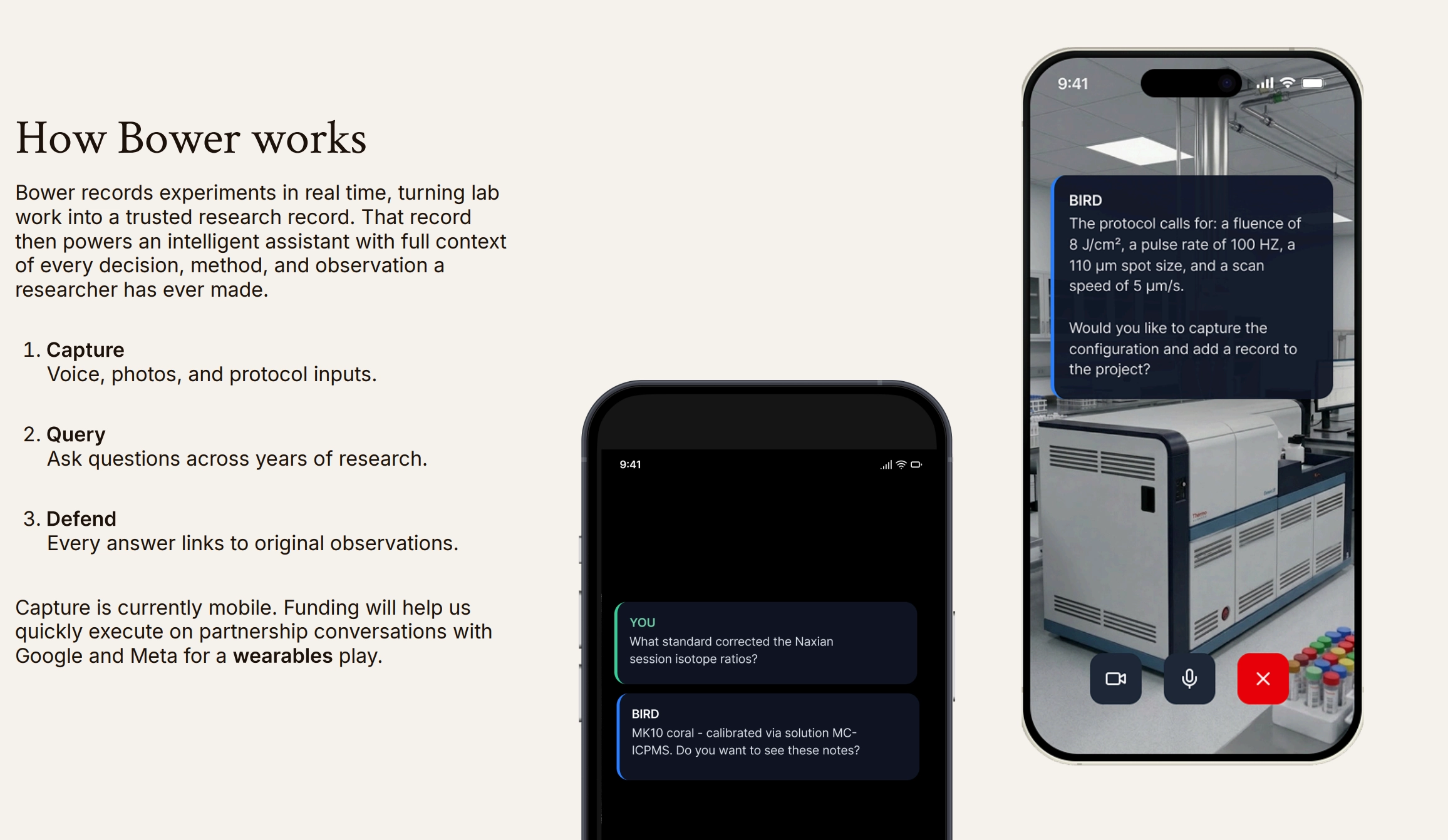
Bower is a working product, built around a key constraint: scientists cannot interrupt their workflow to document it. The core experience is mobile and smart glasses-first capture with desktop organisation and retrieval, and it layers in the intelligence and rigour that research demands.
Capture at the moment of creation. Scientific and medical voice transcription with hands-free, wake-word activation lets researchers narrate their work in sterile labs where phones aren't welcome. Machine vision and photo OCR digitises printed text, handwritten notebooks, and instrument displays, turning decades of undigitised knowledge into searchable content. A protocol-aware AI layer understands experimental methods and flags anomalies in real time - quality control at capture, not weeks later when the experiment can't be redone.
Make it searchable, traceable, and trusted. Everything captured becomes instantly retrievable through natural-language search, underpinned by an immutable, append-only audit trail with full attribution - compliance-ready by design and built to meet the standards research institutions require. Bower also operates as a bridge for modern AI agents, laying the foundation for the wearables era of science.
The ambition is larger than capture. In the near term, Bower becomes the default system of record for how science happens - the layer beneath every experiment that turns spoken observations into structured, reproducible data. As that corpus grows, the same captured data becomes the raw material for scientific output: grant applications drafted in a researcher's own voice, manuscripts assembled from months of structured notes, data summaries generated without a single manual entry. The longer-term vision is infrastructure - a world where every experiment is reproducible because it was captured correctly the first time, every dataset is citable, and the institutional knowledge that has been walking out the door for decades is finally preserved and shared. Bower isn't building a lab notebook. It's building the operating system for science.
And the hardware is arriving right on time. Bower is developing early integrations with smart-glasses platforms, letting scientists capture observations without touching a device - a market growing rapidly, where no one else is building for the researchers who arguably need it most.
We're stoked to be working with Mish, Renaud, James, David and the team. Here's to building the operating system for science.
Check out Bower and join in here.
Safe travels,
The TEN13 Team