

.png)
We've backed Vexev's US$6m Pre-Series A round, alongside existing investors Blackbird Ventures, Neotribe Ventures, Startmate and Horizons. Vexev is the Sydney-built medical robotics company automating one of medicine's most persistent bottlenecks: vascular ultrasound. Vexev is building the autonomous robotic ultrasound platform of the future and we’re lucky to be part of the journey.
Vascular disease is the leading cause of death on earth, claiming close to 20 million lives a year. In many cases it's detectable before it kills, if the right imaging reaches the patient in time. Ultrasound has been the gold standard for vascular imaging for 50 years, but it has one weak point: a trained sonographer, scanning by hand and judgement. Results depend on who runs the scan, on which day, in which clinic. There aren't enough sonographers to go around, and that's a structural problem - training pipelines are long and injury rates in the profession are high, so it isn't something you can hire your way out of.
Dialysis patients feel this most acutely. Anyone starting treatment for end-stage kidney disease needs a vascular ultrasound before they can get the surgical access point dialysis requires, and that scan can't happen in the dialysis clinic itself. It needs a specialist, in a separate facility, often booked out for months. While patients wait, many end up on central venous catheters, which carry a significantly higher risk of infection and mortality than a properly matured access point.
Vexev built VxWave to solve this directly. It's a fully autonomous, AI-guided robotic ultrasound system that produces a complete 3D vascular scan in around 20 minutes, run by a clinical staff member, with no sonographer, no radiation and no contrast dye. It checks its own output against physiological models as it goes, roughly the same check an experienced sonographer runs mentally.
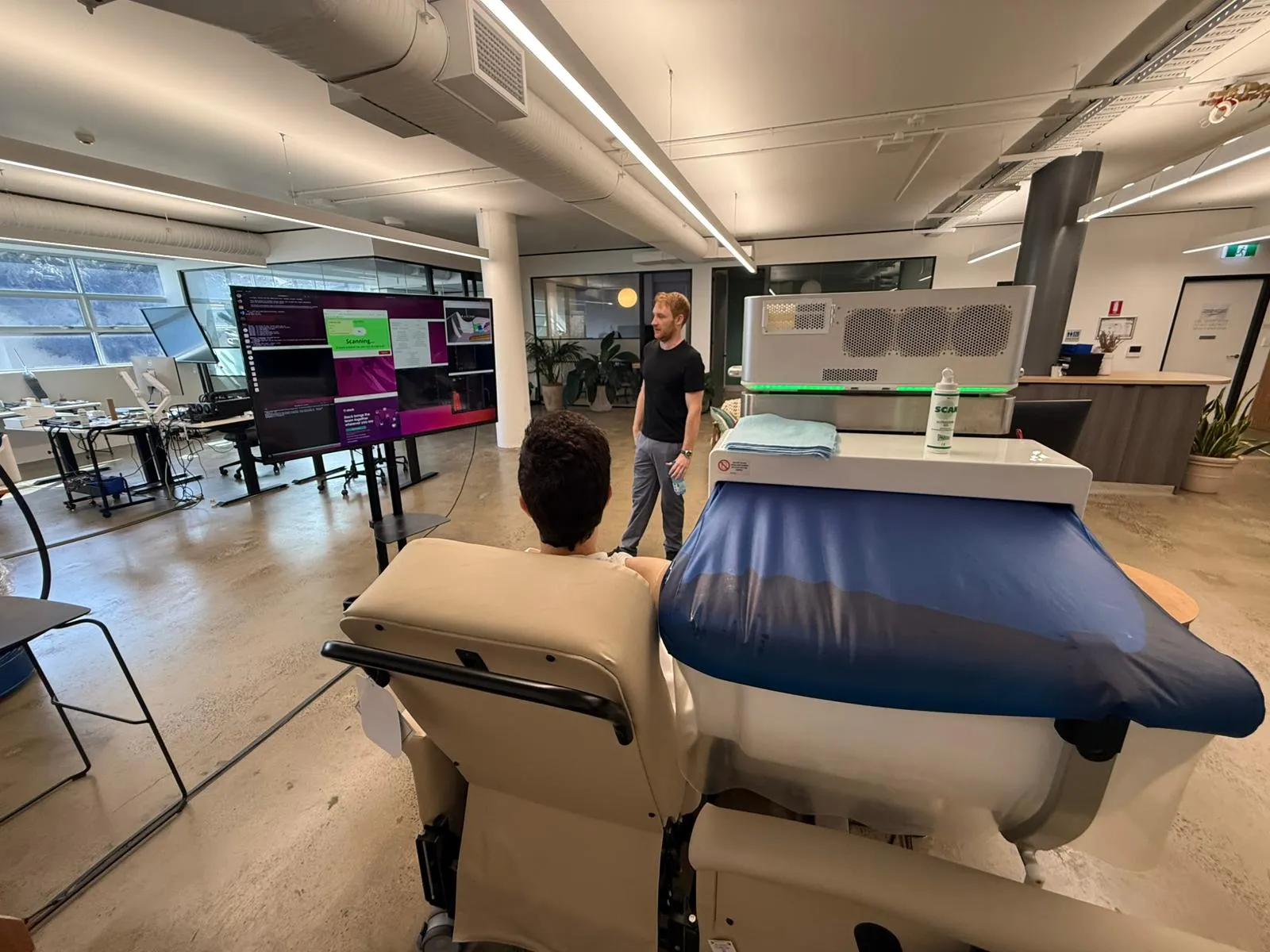
It's a pattern we've been tracking closely at TEN13: the AI companies with the most durable positions tend to be the ones replacing a workflow, rather than software that just helps someone do the same job a bit faster. We hosted Australia's Largest Robotics Party recently, bringing together 160 founders building in this space, and Vexev was one of the strongest teams in the room.
Why we invested
- A decade of research behind this innovative technology: John Carroll and Eamonn Colley did their PhDs together in vascular fluid dynamics at UNSW, studying the exact blood-flow mechanics that VxWave's scan-validation model now runs on. They’ve brought world-class technical depth to solving this problem.
- It's been tested where it matters. In a multi-site clinical study with U.S. Renal Care, VxWave delivered a 94% scanning success rate with non-specialist staff operating it, and reimbursement came through existing U.S. Medicare billing codes in a live clinical setting. Most hardware medtech companies at this stage are still trying to prove the device works; Vexev has already cleared that bar and shown how it gets paid.
- The dataset compounds. Every scan adds to a population-scale record of vascular structure and blood flow that doesn't exist anywhere else today. It's the foundation for a much bigger long-term opportunity: catching cardiovascular disease before it strikes, rather than after.
- Designed and built in Sydney. Vexev designs and manufactures its robotics locally, and is scaling that manufacturing ahead of its U.S. commercial rollout - the kind of hard, physical engineering we think Australia is well placed to export.
John and Eamonn met during their PhDs in vascular fluid dynamics at UNSW and turned that research partnership into a company. They're joined by Dr Shannon Thomas, a practising vascular surgeon at UNSW and Prince of Wales Hospital, as Chief Medical Officer, and Alexis Yates, formerly a government policy adviser and lawyer, as COO. The wider team of 26 has come from Mercedes AMG F1, Tesla, Cochlear, Atlassian, ZOOX, ResMed, Abbott and Philips Healthcare.
The US$6m raise funds FDA 510(k) clearance, manufacturing scale-up in Sydney, and commercial preparation for the U.S. rollout, starting with dialysis vascular access and expanding from there into peripheral artery disease and broader cardiovascular monitoring.
Congratulations to John, Eamonn and the Vexev team, and good to be in this one alongside Blackbird Ventures, Neotribe Ventures, Startmate and Horizon.
Safe Travels,
The TEN13 team.
Learn more about Vexev at vexev.com.